Imagine a US-based DeFi user preparing to move assets from Ethereum to another network before a trading opportunity closes. The route appears simple: connect a wallet, select a token, approve a transaction, and wait. Yet the transaction may involve a bridge, several contracts, token allowances, changing exchange rates, and a destination address on a different chain. A familiar interface can make that sequence feel like one action when it is actually a chain of separate risks.
That is why Rabby wallet cross-chain swaps deserve to be understood as an operational security problem, not merely a convenience feature. A wallet can help users inspect transactions and identify suspicious conditions, but it cannot eliminate smart-contract risk, bridge failure, phishing, market volatility, or careless signing. The useful question is therefore not whether a wallet makes DeFi safe. It is whether the wallet helps the user see what is happening early enough to make a better decision.
What a cross-chain swap actually does
A conventional swap exchanges one asset for another within a single blockchain environment. A cross-chain swap adds a second problem: the asset or its representation must become available on another network. Depending on the route, this may involve a bridge, a liquidity provider, a decentralized exchange on each chain, or a combination of these components.
For example, a user might exchange a stablecoin on one network for another asset on a different network. The route can include a source-chain approval, a deposit into a bridge or liquidity contract, a message or verification process between networks, and a destination-chain transaction that releases or swaps the resulting funds. Some systems lock an asset on the source chain and mint a representation elsewhere; others use pools of liquidity and later reconcile balances. These models have different failure modes.
The first important mental model is that “cross-chain swap” is usually a workflow, not a single primitive. A wallet interface may present it as one quote, but the underlying permissions and trust assumptions remain distributed across multiple contracts and infrastructure providers. A user should ask which chain holds the original asset, which contract receives it, how the destination asset is created or sourced, and what happens if the route pauses halfway through.
Price is only one variable. Slippage describes how much the executed price may differ from the quoted price, while bridge fees, network fees, liquidity depth, and delays affect the final result. A route with the lowest displayed fee may expose the user to thinner liquidity or a more complex contract path. Conversely, a more expensive route may reduce some operational friction without making the underlying bridge risk disappear.
Where Rabby can improve the security workflow
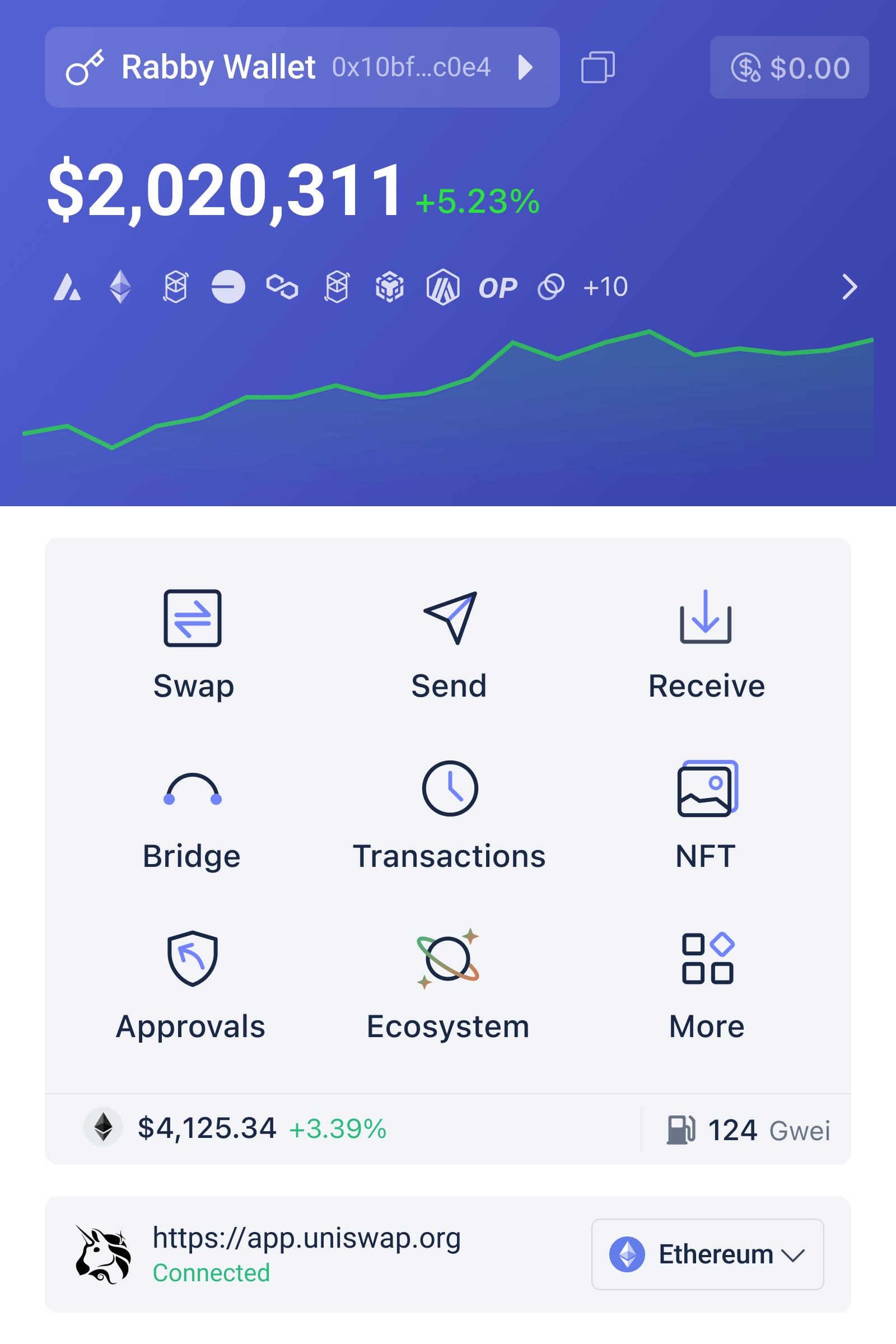
The strongest role for a non-custodial wallet is not to act as a guarantee. It is to improve the quality of the user’s decision before a signature is authorized. Rabby is designed around transaction awareness: showing the network involved, surfacing contract interactions, and helping users review what a proposed transaction appears to do. For a person installing the extension, the practical value lies in treating those checks as part of the signing process rather than as decorative interface elements.
Users considering the rabby wallet should obtain the extension through a source they can verify, check that the browser installation page and publisher information are consistent, and avoid importing a recovery phrase into an unfamiliar website. A legitimate wallet extension does not need a user to reveal a seed phrase to “unlock” an airdrop, validate a wallet, or resolve a failed transaction. That type of request is a classic phishing signal.
Transaction simulation and risk warnings, where available, can be especially useful because blockchain transactions are difficult to interpret from raw calldata alone. A simulation may indicate expected balance changes or a likely failure before the transaction is broadcast. It is not an oracle, however. Simulation results depend on the current state of the blockchain and the assumptions of the simulation system. A state change between simulation and execution, an unusual contract behavior, or an interaction outside the simulated scope can still produce a different outcome.
This limitation matters because users often confuse visibility with safety. A wallet can make a malicious approval more legible, but it cannot revoke an authorization that a user has already granted unless the user takes a separate action. It can identify an unfamiliar contract, but unfamiliar does not automatically mean malicious, and a familiar name does not prove that the contract is genuine. The final security boundary remains the user’s willingness to pause and verify.
The main attack surfaces in a cross-chain transaction
Approvals and unlimited permissions
Many token interactions require an allowance: permission for a contract to spend a specified amount of a token on the user’s behalf. An approval is not the swap itself. It is a permission that may persist after the immediate transaction has finished. If the approved contract is compromised, incorrectly designed, or malicious, an excessive allowance can increase the potential loss.
For routine activity, limiting approval amounts can reduce exposure, although it may require additional transactions and network fees. Reusing an approval can be convenient, but convenience creates a larger blast radius if the contract later becomes unsafe. The appropriate choice depends on the user’s balance, frequency of interaction, and confidence in the protocol. A wallet’s warning is most useful when it prompts this trade-off instead of encouraging automatic confirmation.
Bridges and message-passing assumptions
Bridges are among the most consequential components in cross-chain DeFi because they must establish that an event on one network really occurred before releasing or representing value on another. Different bridges rely on different validator, multisignature, proof, or verification designs. The important distinction is that moving an asset across chains can introduce a new trust assumption even when the original token and destination application are both reputable.
Bridge risk is also not limited to outright theft. A bridge may become delayed, paused, congested, or unable to process a message correctly. The user may then face an operational problem: funds are not necessarily gone, but they are temporarily unavailable or require a recovery procedure. A wallet can help identify the network and transaction sequence, yet it cannot guarantee that an independent bridge will remain available.
Phishing and interface substitution
DeFi users are often attacked before they reach the signing screen. Search advertisements, social-media posts, fake support accounts, cloned protocol pages, and look-alike domains can direct users to an interface that requests a dangerous approval. The visual similarity between a legitimate application and a counterfeit one is not evidence of authenticity.
One practical defense is to separate discovery from execution. Find a protocol through a source you already trust, confirm the domain letter by letter, and then verify the chain, token, recipient, and contract shown by the wallet. Never treat a pop-up claiming that a transaction must be “re-signed” as authoritative. If a transaction unexpectedly requests a permission unrelated to the stated task, reject it and investigate independently.
Private-key and browser risks
A browser extension is convenient because it sits close to the applications a user interacts with. That same convenience creates a local attack surface. Malware, malicious extensions, unsafe browser profiles, remote-access tools, and compromised devices can interfere with the user’s environment. A wallet that protects a private key from the website cannot protect a device that is already controlled by an attacker.
For meaningful holdings, a hardware wallet can add a separate signing boundary, though it introduces its own usability requirements. Users must still verify the transaction on the hardware device when possible, keep the recovery material offline, and understand which actions are being approved. Security is layered: the wallet interface, the device, the signing method, and the user’s habits all contribute.
A disciplined method for reviewing a cross-chain swap
A reusable review method is more valuable than memorizing the names of individual protocols. Before connecting, confirm that the application and domain are correct. Before approving, identify the token, amount, spender, and whether the allowance is limited. Before signing the swap, inspect the source and destination networks, expected output, slippage tolerance, fees, recipient address, and any warning about contract behavior.
Then ask a question that interfaces often hide: what happens if only part of the route succeeds? The answer may involve a delayed message, a destination-side claim, a refund process, or manual support documentation. If the route is unfamiliar, test with a small amount first. A test transaction cannot prove that a system is safe, but it can expose wrong networks, incorrect recipient formats, unexpected fees, and operational delays at limited cost.
It is also useful to distinguish three categories of risk. Execution risk concerns whether the trade completes at an acceptable price. Protocol risk concerns whether the contracts, bridge, and liquidity providers behave as intended. User-environment risk concerns phishing, malware, poor key management, and mistaken approvals. These categories interact, but reducing one does not automatically reduce the others. A wallet may improve execution visibility while leaving protocol and environment risks largely unchanged.
For US users, recordkeeping adds another practical consideration. A cross-chain route may create multiple on-chain events rather than one simple disposal or acquisition. Depending on individual circumstances, swaps, bridge movements, liquidity actions, and token receipts may have different reporting implications. A wallet can help users trace activity across addresses and networks, but it is not a tax adviser. Keeping transaction hashes, timestamps, asset amounts, and fee information is sensible, particularly when an operation involves several chains.
What to watch as cross-chain UX develops
The likely direction of wallet design is more contextual signing: clearer explanations of contract effects, better simulation, stronger detection of suspicious approvals, and more structured warnings for cross-chain routes. If those tools improve, users may make fewer errors because the interface maps technical actions to understandable consequences. That is a conditional benefit, not a certainty. Warning systems can produce false positives, miss novel attacks, or become so frequent that users learn to dismiss them.
The deeper issue is incentive design. A fast, inexpensive route may be attractive because it reduces friction, but friction sometimes performs a security function by giving a user time to notice an unexpected approval or destination. The best interface will not simply remove every extra step. It will distinguish harmless repetition from moments where deliberate review is justified.
No recent project-specific news is available for the current eligible week, so there is no new Rabby development to treat as evidence of a changed security posture. Users should therefore evaluate the extension and any connected protocol based on the current interface, verified installation source, transaction details, and the independent risks of each route. Product branding should never substitute for contract-level and operational review.
Frequently asked questions
Does Rabby make cross-chain swaps safe?
No wallet can make cross-chain swaps safe by itself. Rabby may improve transaction visibility, simulation, and warning signals, but bridge contracts, decentralized applications, market conditions, browser security, and user decisions remain outside the wallet’s complete control. Treat its alerts as decision support, not insurance.
What should I check before approving a cross-chain swap?
Verify the application domain, source and destination networks, token and amount, spender address, approval size, expected output, slippage, fees, recipient, and any required follow-up action. If the route is unfamiliar or the transaction requests a permission that does not match the stated task, stop and investigate before signing.
Is a small test transaction enough to prove a bridge is trustworthy?
No. A test can reveal operational mistakes and show whether a route behaves as expected, but it does not establish that the bridge is secure under stress or that its contracts will remain safe. Use testing as one layer of risk control, alongside independent protocol review, limited approvals, device security, and sensible position sizing.
The central lesson is simple but easy to overlook: cross-chain convenience compresses many technical decisions into one polished screen. A security-conscious user decompresses them again before signing. Rabby can be useful in that process when its warnings and transaction details are treated as prompts for verification. The wallet is not the security model; it is one instrument within a broader model built from limited permissions, verified interfaces, layered custody, and the discipline to decline a transaction that does not make sense.